By Robert S. Katz and Sonia M. Okolie
The USPTO will soon be issuing updated guidelines for applicants and examiners for design patent applications directed to computer-generated interfaces (e.g. GUIs) and icons. The incoming Guidelines change course from the prior Supplemental Guidance issued in November 2023, which was later incorporated into the Manual of Patent Examining Procedure (MPEP). These Guidelines are welcome news for innovators who create designs in this category and for the practitioners who represent them.
In creating the updated Guidelines, the USPTO considered the comments on the 2023 Guidance and feedback from stakeholders addressing the nuances of design patent practice and potential limitations to the scope of protection for GUI and icon designs under the existing requirements. The Guidelines successfully make the examination rules more current so that they no longer reflect the state of computer-generated design art when the Board decided Ex Parte Strijand (26 USPQ 2d 1259 (BPAI 1992)) over thirty years ago, as well as bringing the U.S. practice closer to that of the EUIPO and other countries worldwide.
This new guidance effectively provides applicants greater flexibility in how they choose to protect their graphical user interface and icon designs. The Guidelines apply retroactively to pending design patent applications too, not only to applications filed after the Guidelines publish. Additionally, the Guidelines remove some prosecution traps that have been known to ensnare inexperienced applicants filing via the Hague Agreement and even inexperienced representatives too.
This Alert highlights some of the changes included in the new Guidelines:
A. Designs for Computer-Generated Interfaces and Icons are Statutory Subject Matter
Previously, the USPTO required that applicants depict the design claim directed to a computer display to which the GUI or icon was embodied. The USPTO now acknowledges that the design of a computer-generated interface or icon is statutory subject matter when it is for a computer, computer display, or computer system because the GUI and icon are more than a mere transient or disembodied picture. Therefore, this category of designs is indeed patent-eligible subject matter when properly disclosed and claimed according to the relevant rules and statutory requirements.
The Guidelines remain consistent with this principle when it comes to the application title and claim language. A design patent which claims a GUI or icon “for” a computer will satisfy the requirements under § 171, and examiners are no longer instructed to issue objections to these titles and claims. This will enable applicants to center the title and claim of the application on the GUI/icon, rather than the computer display screen. This flexibility has a further benefit of likely reducing objections and rejections applicants face in this design art.
B. No Broken Line Computer Screen Requirement
Design applications for GUIs/icons have historically depicted a broken-line boundary in the drawings representing the display screen or panel. In fact, the failure to do so would incur a rejection under 35 U.S.C. § 171. Now, applicants will no longer be required to depict the display screen in solid or broken lines in the drawings, provided that the application title and specification clearly identify the article of manufacture. Applicants may still include the broken-line boundary in the drawings, but the requirement has been eliminated.
C. More Modern Types of Graphical User Interfaces are now Expressly Patentable
The USPTO was previously somewhat inflexible regarding modern types of computer-based designs and required that two-dimensional designs be shown on a display panel. However, the new Guidelines look to the principles set forth by the CCPA in In re Hruby (373 F.2D. 997 (CCPA 1967)), updating the practice to no longer reflect the state of computers from 1992 and instead address recent technology. So, under the new Guidelines, additional types of patent-eligible designs including designs depicted in projections, holograms, virtual and augmented reality will be protectible as long as they are presented properly.
D. Updated Guidance and Examples are Included for Reference
The Guidelines provide helpful examples of titles, drawings, and claim language that will comply with § 171. For example, the titles: (1) Computer Icon, (2) Graphical User Interface for Display Panel, (3) Projected Interface for a Computer, (4) Virtual Reality Interface for a Computer, and (5) Augmented Reality Interface for a Computer, will now be deemed acceptable.
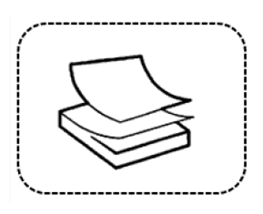
With respect to the drawings, applicants are no longer required to depict the computer screen for GUI and icon designs. This is demonstrated in the two alternative acceptable figures of a “Paper Stack Icon for a Computer Display Screen” provided in the Guidelines and in the table below. Thus, in addition to the flexibility in title, applicants may now choose whether to depict the icon without a broken-line boundary because the title clearly indicates the article of manufacture is a “computer display screen”.
“Paper Stack Icon for a Computer Display Screen”
 |  |
Conclusion
These Guidelines are a positive development for those who create computer-based designs. As these Guidelines will publish imminently, we recommend applicants consider strategy for depicting GUI, icon, and AR/VR designs, and potentially craft titles, claim language, and drawing figures that provide a stronger and broader design right. Practitioners should carefully review these Guidelines and its examples and stay current regarding how design patent examiners are applying them. As always, applicants will need to remain mindful of all patentability and enablement requirements. Nonetheless, applicants who create in this space should be excited about this development.
Posted: March 13, 2026