By Brad Van Pelt and Sarah Meece
The Federal Circuit has issued its decision in Jacki Easlick, LLC v. AccEncyc US, Nos. 2024-1538, 2024-1826 (Fed. Cir. Aug. 14, 2026). Writing for the panel of Judges Dyk, Schall and Prost, Judge Prost affirmed the Western District of Pennsylvania’s denial of a preliminary injunction and its denial of reconsideration. The nonprecedential opinion held that the district court did not abuse its discretion in finding no likelihood of success on the merits and no showing of irreparable harm. The panel expressly sidestepped the propriety of Schedule A litigation.
Key Takeaways from Nonprecedential Decision
• Identifying and relying on distinguishing ornamental features is not legal error, provided the court compares the overall visual effect rather than features in isolation.
• Prior art need not be consulted where the designs are plainly dissimilar.
• Conclusory assertions of lost profits, goodwill, or customer confusion, supported only by case law citations, do not establish irreparable harm.
• An ex parte TRO does not constrain the court’s independent preliminary injunction analysis, and a defendant’s silence on irreparable harm does not shift the plaintiff’s burden.
• The court declined to opine on the propriety of Schedule A practice, despite an amicus brief submitted by several law professors.
Background
The asserted patent, U.S. Design Patent No. D695,526 (“the ‘526 patent”), claims a hook for hanging handbags on closet rods, and is associated with Jacki Easlick’s TOTE HANGER® product. On November 20, 2023, Jacki Easlick, LLC and JE Corporate LLC sued 67 online sellers in the Western District of Pennsylvania in a “Schedule A” action, alleging infringement of the ‘526 patent. The district court granted an ex parte TRO against all defendants the same day. The district court denied a preliminary injunction as to AccEncyc, finding that Easlick had not established a likelihood of success on the merits nor irreparable harm, and later denied reconsideration. The remaining defendants either entered a consent order or faced default judgment.
Infringement Analysis
Easlick’s challenge on the finding of no likelihood of success rested on two arguments: (1) that the district court improperly focused on individual design details, and (2) that it failed to consider the prior art. The panel rejected both.
On the first argument in relation to the district court improperly focusing on individual design details, the court explained that where a design contains both functional and non-functional elements, claim scope must be construed to identify the non-functional aspects. The district court had excluded the two attached hooks and the vertical configuration as functional, while identifying as protected ornamental features the shape of the hooks, the flare out of the top hook’s tip, the 90-degree offset at the top and bottom hooks, and the spheres on the end of each hook.
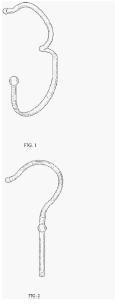 | 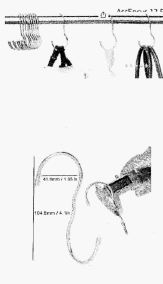 |
| Asserted Patent | Accused Product |
The district court found that comparisons would not deceive an ordinary observer into thinking that any of the accused designs were the same as the patented design, identifying the corkscrew-like center of the patented design against the laterally bent center of the accused product as the most obvious difference, along with the shape of the bottom hooks and the hooks’ finished ends. Easlick argued such concentration on isolated differences ignored the overall impression of the two products. The Federal Circuit disagreed, noting that the district court had expressly stated it was “comparing the overall visual effect of the two products” and had analyzed how the ornamental features impact the overall design. The panel added that considering distinguishing features is not legal error, and that “it is hard to imagine how a court could reasonably conduct this analysis without pointing such features out.”
On the second argument relating to the prior art comparison, the panel held that comparison with the prior art “is beneficial only when the claimed and accused designs are not plainly dissimilar.” In any event, the district court had explained in denying reconsideration that a prior art analysis would not have changed the result, because the submitted prior art differed from the claimed design in several respects and reapplying the ordinary observer test would not have altered the overall visual effect in comparing the two designs.
Irreparable Harm
The panel held that the district court appropriately found no irreparable harm. Easlick advanced three arguments: that the district court should have remained consistent with its TRO ruling; that AccEncyc’s failure to brief irreparable harm was significant; and that its evidence was sufficient. Easlick had the burden regardless of whether AccEncyc responded. And “[t]he decision to grant an ex parte temporary restraining order against 67 defendants does not restrain the district court’s separate analysis of a motion for a preliminary injunction.” On the merits, the district court had properly found the alleged harms to profits, consumer relationships, brand value, goodwill and reputation “nothing more than conclusory and theoretical,” and the panel opined that mere citations to case law recognizing categories of harm, coupled with conclusory assertions that they are occurring are inadequate and do not meet the burden.
Reconsideration
Reconsideration serves to correct manifest errors of law or fact or to present newly discovered evidence requiring extraordinary circumstances. Easlick’s proffer of the physical hooks and further testimony did not qualify because there was no reason it could not have submitted that material before the preliminary injunction motion or hearing, and “new evidence” means evidence that was not previously available.
Sidestepping Schedule A Litigation
Schedule A cases involve suits against numerous online sellers, frequently filed under seal and supported by requests for immediate ex parte relief. These cases have become a widely used enforcement tool against online retailers. This case presented the recurring features of the model: ex parte relief affecting defendants before notice, aggregation of potentially unrelated defendants, standardized evidence of infringement and harm, and significant commercial consequences including frozen funds and suspended storefronts. An amicus brief from several law professors argued that Schedule A cases are legally permissible and described this suit as a typical example, where a TRO issued before the appellee had notice or an opportunity to contest the allegations. The Federal Circuit declined the invitation to weigh in, stating simply that “[t]he propriety of the ‘Schedule A’ practice is not before us.”
Posted: August 18, 2026