By Richard Stockton, Principal Shareholder
“Plain dissimilarity,” the U.S. design law assessment that enables judges to decide design patent infringement issues before trial based on allegedly clear visual differences between claimed designs and accused products, continues to gather steam following a new Federal Circuit opinion. But one judge thinks plain dissimilarity has gone too far.
In Range of Motion Products, LLC v. Armaid Company Inc., No. 23-2427 (Fed. Cir. Feb. 2, 2026), the Federal Circuit affirmed summary judgment of noninfringement of U.S. Design Patent No. D802,155 titled “Body Massaging Apparatus”:
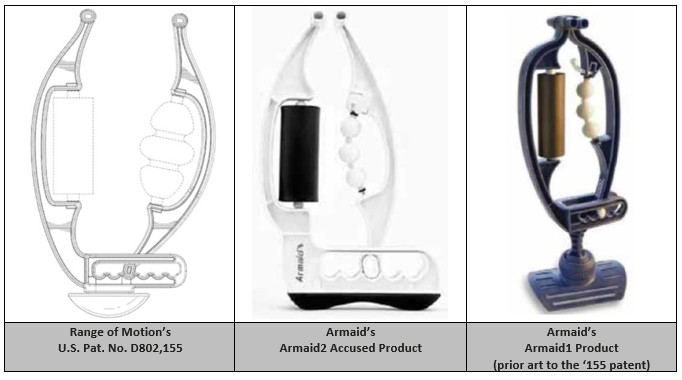
The accused product, Armaid’s “Armaid2,” is the successor to Armaid’s “Armaid1” product, which dates to the 1990s and is prior art to ROM’s D‘155 patent.
In granting summary judgment of noninfringement, the district court said it would consider “functional features of the D’155 patent only to the extent that they contribute to the overall ornamentation.” Such functional features appear to include, e.g., the “clamshell” arms. The district court also noted some “largely ornamental” features relating to the device and its arms, including the “thick ridged outline.” Ultimately, the district court opined that the D’155 patent’s “many functional elements and its minimal ornamentation” made the overall claim scope “narrow.” The district court then granted summary judgment because “the ornamental aspects of the two designs are plainly dissimilar, such that ROM cannot show patent infringement as a matter of law.”
On appeal, ROM argued, among other things, that the district court’s analysis “improperly eliminates entire structural elements” like the “shape” of the arms from the infringement analysis because those elements are allegedly functional. Writing for a 2-1 majority at the Federal Circuit, Judge Cunningham (joined by Judge Hughes) disagreed. The majority concluded “the shape of the arms is functional” and that “the district court did not err in construing the claim to identify the functional versus the ornamental aspects of the arms (and the overall design).” And although the majority disagreed that the district court “entirely eliminated” functional features, it acknowledged that the district court could “account for” those features when analyzing infringement.
Accordingly, the majority approved the filtering out of functional features (other such features appear to include the “inverted mushroom” base, “open slot at the end of the hinge” and the “oval connector pivots”) before the D’155 patent and the accused design were compared for infringement. The majority also approved the district court’s conclusion that no legitimate infringement fact question remained for a jury, i.e., the D’155 patent and the accused product were “plainly dissimilar” based on what was left.
In dissent, Chief Judge Moore asked “[i]s it really the case that no reasonable juror could find the designs at issue substantially similar?” She asserted that the district court wrongly focused on “minute differences in each element” instead of overall similarity, something that the filtering accentuated. Moreover, she challenged the growing number of affirmances of dispositive noninfringement motions based on “plainly dissimilar” language from the en banc Egyptian Goddess decision and instead called for a return toward a factfinder always assessing similarities in light of the prior art.
Chief Judge Moore has a point. The Egyptian Goddess “plainly dissimilar” language is arguably dicta, and in any event may not have been intended to foster dispositive motions that truncate a factfinder’s critical role in evaluating infringement. And whatever the propriety of filtering out functional features, here the filtering had a major impact on a comparison of two items that may otherwise look substantially similar to a lay observer. In other words, the “plainly dissimilar” assessment may be being stretched too far.
Currently, petitions for rehearing and rehearing en banc are due on or before March 4, 2026. Unless a rehearing petition is filed, any petition for writ of certiorari is due on or before June 1, 2026.
Posted: February 17, 2026